Tag Archives: Hong Kong

High School Musical: Live On Stage @ HK APA review

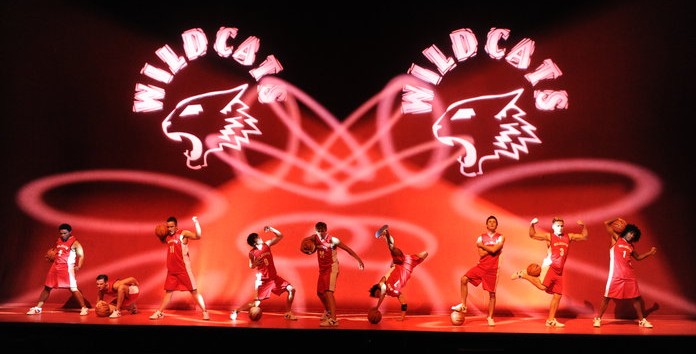
Is there any point to High School Musical if there isn’t Zac Efron to drool over? With the arrival of High School Musical: Live On Stage to Hong Kong’s Academy of Performing Arts, it was my chance to find out!

Lack of Efron aside, I had also worried how the soundtrack, largely made up of rather slight pop songs, would translate to the more complex arrangements of musical theatre. Luckily, the majority have been substantially and successfully beefed-up – Start Of Something New is transformed from treacly to terrific, making for a rousing multi-layered opener, whilst When There Was Me And You morphs from weak Vanessa Hudgens solo to deluxe power-ballad duet.

However, the biggest problem lies in the script, which was hardly a masterpiece in its TV movie origins and hasn’t got much better with stage treatment. I doubt the writers unduly taxed themselves when they sat down to make the easiest buck of their life by adapting the film for theatre – some parts are lifted almost wholesale from the movie (including a cringeworthy section about wanting to be best friends at kindergarten), other parts heavily rely on Grease for “inspiration”, there are cultural references that would barely translate to Hicksville parts of America, let alone to an international audience and the actual dialogue itself is simple, workmanlike and generally not as funny as it could have been. Whilst this isn’t really a problem when you’re pitching yourself at an audience that already knows the plot, characters and songs inside-out (and I think you can guess at the complexity of these elements given the number of five year olds experts on HSM), it’s up to the cast to sell the production – and that they must definitely do.

This energetic, enthusiastic 30-strong ensemble makes the hyperactive kids on Supernanny look like slackers. All-singing, all-dancing, all-smiling – I could barely keep up with them and I was only watching! The dancing in particular is full-on throughout and always exciting given the sheer number of performers executing one slick move after another, whilst chucking some break-dancing into the mix was a nice touch.

hsm hk 5 troy gabriella

As for the main characters, Max Milner, as basketball-wielding dreamboat Troy Bolton, manages to out-Efron Efron and makes the part his own. He has a sweet acting-style, turning in a charismatic, naturalistic performance that makes him the kind of boy that all mothers would delight in their daughters bringing home. Brainiac Gabriella Montez was irritatingly drippy in the film – and not just because I’m jealous that Vanessa Hudgens gets to bang Efron in real life – but Talia Kodesh turns on the charm and has an endearing twinkle in her eye throughout. Their strong vocals carry the show (Where There Was Me And You is fantastic) and Milner especially has a gorgeous tone. Kyle Grant will probably need testosterone injections for the rest of his life to combat damage done by the tight pink shorts he dons as Ryan and I was impressed with Tsephi Mash as Taylor McKissie, the weakest link in the movie since the actress who played her (Monique Coleman) could neither sing, dance nor act particularly well. Despite this underdeveloped role, Mash is a bubbly vibrant presence on-stage and turns almost all her lines into winners.

I wish I could say the same for Sharpay. Ashley Tisdale’s scene-stealing diva turn in the film was the knowing wink at the heart of the franchise, stopping it from becoming a molten crème brulee of saccharine tweendom, and should be a gift of a part. However, Raquel Munn seems to have taken her performance cues from a line about her character being named after a dog and raised her pitch to being audible to canines alone. She’s nasal, screechy and annoying – which is certainly one way to play Sharpay (but I would say, not the best one) – with zero warmth, a total lack of funny lines (the script’s fault) and makes her songs a pain to sit through.

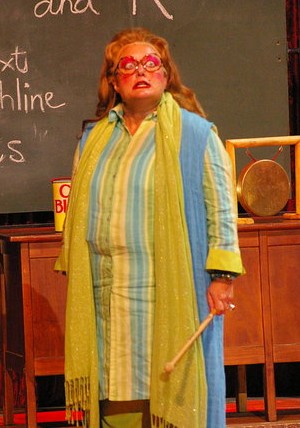
Moreover, there is only room for one ham in this show and Robyn Sara Scott as histrionic drama teacher Miss Darbus has it covered. Once this production rolls into China, it won’t just be the Great Wall you can see from space – Scott’s performance will be right up there too. This is an acting style that makes Brian Blessed look restrained. Quite frankly, I’ve never seen anything like it and I doubt Hong Kong has – or ever will again! Entertaining and terrifying in equal measure, I can only hope this was the performance of Scott’s life as the possibility that anyone doesn’t have to act their socks, shoes and blisters off to produce such an unhinged creature is too horrifying to comprehend.

It’s perhaps fitting that High School Musical: Live On Stage truly takes off at the ‘soaring flying’ show climax of Breaking Free. Finally, the writers get their heads in the game, sending the cast swarming into the audience to cheer us into submission, creating a truly immersive invigorating experience. The action is meant to be taking place in a theatre and suddenly, we’re a part of it and it becomes the pure joyous stuff that live musical theatre thrives on. The party atmosphere really kicks in with the high-octane ten-minute closing Megamix, which almost has as much oomph as the rest of the show put together. To resist is impossible, so don’t even try to deny it.

Whilst I’m not sure if High School Musical: Live On Stage has the ingredients to become a classic still doing the rounds decades from now, what is certain is that however long it lasts, it will have a hell of a lot of fun along the way. Go Wildcats!

(And yes, it just about works without Zac Efron.)

GWB Entertainment’s production of High School Musical: Live On Stage, Hong Kong Academy of Performing Arts, 13-19 September 2010.

The Asian tour will stop off at Beijing, Shenzhen, Wuhan, Guangzhou and Chongqing in China and later, Taiwan.

All photos from HSM: Live on Stage in Hong Kong’s Facebook

The Lodger: Hitchcock Retrospective @ HK Film Archive review

People say silence is golden but is this the case for cinema? I decided to put this theory to the test with The Lodger: A Story of the London Fog, the first film and only silent one in the LCSD’s current Hitchcock retrospective.

Although it was Hitchcock’s third film, it is widely-regarded as the first “Hitchcock” film, setting in motion his signature style. Having never seen a silent movie in a cinema before, keen to see the beginnings of Hitchcock’s trademark thrillers and hardly breaking the bank at fifty bucks per ticket, I thought it would prove to be an interesting experience.

The Lodger is Hitch’s take on the Jack the Ripper story. A serial killer murders blonde women around foggy London on Tuesday nights, leaving a calling card of ‘The Avenger’. A witness describes him as having a scarf pulled up round his face – cue a mysterious stranger, complete with scarf pulled up round his face, arriving at a boarding house nearby i.e. the eponymous lodger (Ivor Novello). He soon gets friendly with Daisy, the pretty blonde daughter of the house, whilst skulking around the place and acting creepily enough to arouse the suspicions of anyone with eyes and a functioning mental capacity. Is he The Avenger? Will he kill Daisy? Will anyone tell him to tone down on the creepy front?

I found The Lodger more interesting in terms of witnessing the start of Hitchcock’s development rather than a film in its own right, and there are plenty of distinctive Hitchcock motifs – the pursuit of an innocent man, the obsession with blondes, a bathroom scene, touches of humour, strong visuals and innovative shots – to keep the average film geek going. The opening close-up of a woman screaming as she is being murdered (back-lit to emphasise her halo of fair hair) is pure Hitchcock, whilst a clever shot that sees the nervous landlords look up at their shaking chandelier, dissolving to the Lodger’s feet pacing the floor above it (achieved by shooting his feet from under a glass floor) is unbearably tense. And if you thought that The Thomas Crown Affair is the ultimate in sexy chess scenes, there’s a really sensual one here albeit with a dangerous undercurrent about forty years early!

It was also interesting to see Ivor Novello, the actor and matinee idol, rather than just the long-forgotten name behind a prestigious song-writing award. He’s actually rather beautiful, with his feminine lips and milky pale skin set to glow, but he overacts to such an extent that his performance practically reaches the exhibition hall downstairs. He arrives on-screen looking and acting like Nosferatu and I haven’t seen an actor delight in being so obviously sinister since the audience burst out laughing at how weird (and seemingly talcum powder covered) the Cullen kids were in their first appearance in Twilight. There’s an ultra-magnified close-up of his kissing lips that may have had the swooning audience of the 20s reaching for their hankies in pleasure yet it’s just gigglingly uncomfortable nowadays.

Whilst Novello just about gets by on charm alone, I can’t say the same for the unsatisfying anticlimactic ending. Given Ivor Novello’s heartthrob status plus the fact that Hitch would surely never be so obvious, the Lodger’s innocence is never really in doubt (although Novello’s acting does suggest that he should have been sectioned along the way) but for us never to find out who The Avenger really was is a bit of a damp squib. Apparently, Novello’s popularity put the clappers on any earlier ideas Hitchcock had about making his identity a more ambiguous affair whilst right until the final shot, I was still hoping for a twist that would see Daisy’s jealous cop boyfriend or her dim father turn out to be the one wot dunnit. Instead we get a baying mob persecuting The Lodger (in an admittedly thrilling sequence that was the only part of the film to elicit an audibly excited response from the audience when I saw it) and a prolonged happy ending. There is only the sight of the ‘To-Night Golden Curls’ visual motif, flashing in the background as it has repeatedly throughout the film and The Avenger’s reign of terror, to provide a very slight ominous touch.

Seeing the film in complete silence meant that every other sound in the small cinema at Sai Wan Ho’s Film Archive was magnified – sadly, in my case, this meant the stomach rumblings of the old man nodding off next to me. Unlike black-and-white as opposed to colour films, or hand-drawn animation as opposed to CGI, I really felt that the lack of sound meant something vital was missing. It’s worth pointing out that even in 1927, the audience wouldn’t have been sitting in complete silence like we were – there would have been live musical accompaniment, with a score performed by a pianist during the film to heighten the moods depicted on-screen. This screening would have been undoubtedly improved had the LCSD thought to do the same – given the space constraints, at least a man on a Yamaha keyboard or, joking aside, a CD player using the score from DVD versions of the film could have been managed.

However, seeing The Lodger on the big screen is still worth fifty of your best Hong Kong dollars. As with most silent (and indeed Hitchcock) films, there is barely an ounce of fat on the film and it zips by at a brisk, eminently watchable pace. Having over 100 people gathered to watch a film over eighty years old and basking in the near enough complete silence, especially in frantic eternally-modernising Hong Kong, has a special charm all of its own.

6/10

The Hitchcock Retrospective, 10 September until 28 November 2010, comprises of 20 films shown twice at the Film Archive, Space Museum or Science Museum. Tickets cost $50 from www.urbtix.hk (worst ticketing website in the world, seems to have been built in the 90s).

Each film has two showings, with the season quite heavily biased towards Hitch’s earlier films (Rear Window and The Birds are two notable omissions), but seats are limited and many of the most famous ones have already sold out. All films are screened in English only, whilst a series of lectures ($80 each) are all conducted in Chinese!

Film Archive, 50 Lei King Road, Sai Wan Ho, 2739 2139. http://www.filmarchive.gov.hk

Crabtree & Evelyn Tearoom review – tea for two?

UPDATE: Crabtree & Evelyn Tearoom is now closed.

Afternoon tea with jam, cream and scones is practically a British institution, right? Except I know of not one person in Blighty that partakes of this quintessentially English meal.

Of course, that hasn’t stopped the art of afternoon tea being embraced by most luxury hotels and their dining establishments here in Hong Kong… and even some not so luxury ones, if the ‘high tea set’ at Spaghetti House is anything to go by (it includes crisps and chicken wings… high tea at a five year old’s birthday party perhaps). In fact, enjoying the tea set at the Peninsula has become one of those ‘must-do’ things here (I’ve done it twice and yes, it goes on the long list of things I mean to write about eventually). However, the Crabtree & Evelyn Tearoom must be one of the few places in HK that specialises only in serving afternoon tea – well that and being quality purveyors of nice-smelling hand cream.

You’d never guess that this quaint little corner of Little England would be tucked away in a nondescript office building in Wan Chai. Crabtree & Evelyn has always cultivated a traditionally English image so I was somewhat surprised to discover that the company is actually American and was founded in the late 1970s. They certainly had me fooled – and with their Tearoom, complete with floral crockery, relaxed atmosphere and scones laden with cream and a variety of jams, they’ve successfully managed to keep up the illusion of being every bit as old-world as the tearooms you might find in an Agatha Christie novel.

Enjoying your tea set – and you really should take time to enjoy it, as that’s practically the whole charm of the thing – is as much about lusting after the pretty-as-a-picture tableware as it is about the food itself. I knew I’d died and gone to chintzy heaven when even the printed napkins matched the teapots. (So much so I banned my boyfriend from using his, so I could take them home to stroke lovingly).

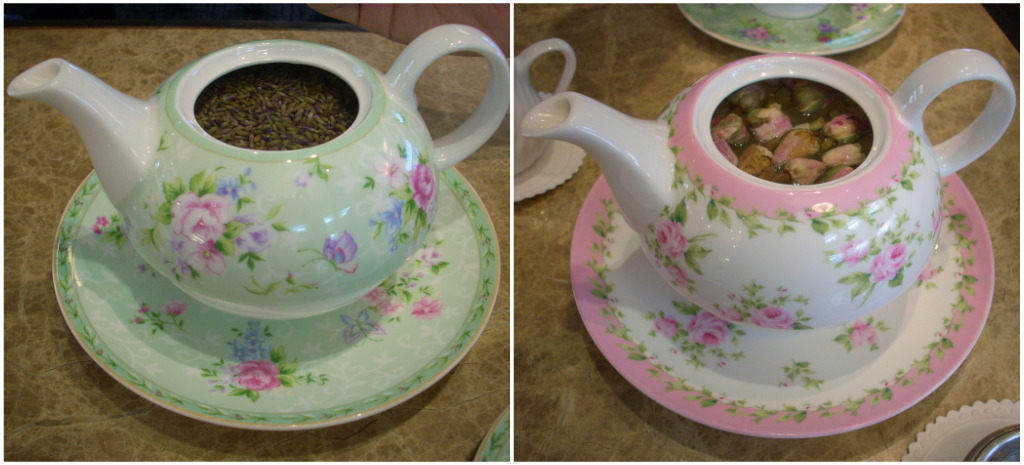
I opted for the rose tea, whilst the boyfriend went for lavender with the menu listing the various health properties each type of tea has – let’s say the rose tea was a little too good for my digestion, if you catch my drift! But it’s always fun to see what looks like pot-pourri floating in your brew and the fragrance was really rather pleasant. The lavender one did taste a bit too much of garden but the rose was not too strong and had a nice, clean taste, both getting considerably better once you stirred in some honey!

The food itself was a little hit and miss. The undoubted star of the set were the scones, which came with enough types of jam to make the WI’s stall at the village fête look positively understocked in comparison. They were warm, buttery, claggy mounds of scrumptious, especially when smeared with liberal lashings of cream and jam. The only sad thing is that scones are so filling, we didn’t manage to polish off the lot! I’d say they were superior to the ones at the Peninsula, to be honest.


The rest of the sweets were decidedly less sensational. There were some fruit tarts that looked better than they tasted, with the fresh fruit element much nicer than the bland hard pastry. The kiwi-topped one had some kind of custard in it that was far too sickly sweet; sorry Mr Crabtree, but Maxims can do better. Eating the four small chocolates was like a confectionary-based form of Russian roulette – my first attempt was a marzipan one, which was disgusting, mainly because I hate marzipan. My boyfriend got luckier with a plain chocolate one with a gorgeously gooey centre, and there was another nice one that had crispy bits in. The final one had the word Amaretto on it, so at least the rich kick of alcohol was expected. It reminded me of that chocolate-eating face-off ad for Revels (‘Coffee!!!’); since they’re small and all different, it makes sharing with your partner-in-crime a little difficult!

Finally, the savouries. To be honest, I was unable to distinguish any difference between the pastries so could not begin to guess what they were filled with! They were acceptable but not exceptional. The sandwiches, however, were in a different league. Then again, I’m a big fan of sandwiches as part of afternoon tea although in any other setting, I won’t touch them! Lovely, soft, fresh white bread (can’t stand places that try and fob me off with brown or worse, wholemeal), filled with lovely soft fresh fillings. Delightful. One was the classic combination of tuna and cucumber (again, I won’t touch cucumber in any other setting!), the other was sliced chicken. There’s nothing more simple than a sandwich but I guess the genius of these were that they really reminded me of what I’d get back home. The best sandwiches are so light you don’t even realise they’re gone until your hands are empty and these were exactly that.


The tea set for two clocks in at $298, which I’d describe as reasonable value for the whole experience rather than just the food itself (HSBC credit card holders also get 10%, which basically cancels out the service charge). I think The Tearoom is also the only place where Crabtree & Evelyn’s beautifully-packaged cookies and preserves are available for sale. It’s best for a lazy day where you can enjoy the meal in the lovely atmosphere – namely, with the divine scent of Crabtree & Evelyn toiletries floating in the air (you actually get a gift-boxed hand cream free; alas, the jar of honey that other reviewers have commented on is now reduced to a jug of the stuff that cannot be taken away!). Even the furniture has an English country house feel, with plush high-backed chairs, marble tables and a pretty veiled gazebo outside if you dare to brave non air-conditioned HK weather. There are only a few tables and given that it is still a shop, you do get customers wandering in, which can feel a little weird as you’re scoffing down your scones. We went on a weekday afternoon, meaning we were the only customers and able to enjoy our meal in peace, quiet and luxury although I imagine weekends are much busier and you’d have to book.


Overall, I had a luverly time but I’m not sure I’m in a hurry to go again, especially as there are so many tea sets to try out in HK. But it was worth it for the atmosphere, which really did feel like home – or at least, the chocolate-box version of it. I even felt like I had to watch my table manners (of course, I always do!), hold my teacup with my pinkie sticking out and come suitably attired (I wore a dress)! Definitely one for girlie girls looking to coo over pretty plates – just don’t hold me responsible if you find yourself disillusioned with Ikea’s finest afterwards!

Shop 126, Sun Hung Kai Centre, 30 Harbour Road, Wan Chai, Hong Kong 2511 0868

Afternoon tea with jam, cream and scones is practically a British institution, right? Except I know of not one person in Blighty that partakes of this quintessentially English meal.

Of course, that hasn’t stopped the art of afternoon tea being embraced by most luxury hotels and their dining establishments here in Hong Kong… and even some not so luxury ones, if the ‘high tea set’ at Spaghetti House is anything to go by (it includes crisps and chicken wings… high tea at a five year old’s birthday party perhaps). In fact, enjoying the tea set at the Peninsula has become one of those ‘must-do’ things here (I’ve done it twice and yes, it goes on the long list of things I mean to write about eventually). However, the Crabtree & Evelyn Tearoom must be one of the few places in HK that specialises only in serving afternoon tea – well that and being quality purveyors of nice-smelling hand cream.

You’d never guess that this quaint little corner of Little England would be tucked away in a nondescript office building in Wan Chai. Crabtree & Evelyn has always cultivated a traditionally English image so I was somewhat surprised to discover that the company is actually American and was founded in the late 1970s. They certainly had me fooled – and with their Tearoom, complete with floral crockery, relaxed atmosphere and scones laden with cream and a variety of jams, they’ve successfully managed to keep up the illusion of being every bit as old-world as the tearooms you might find in an Agatha Christie novel.

Enjoying your tea set – and you really should take time to enjoy it, as that’s practically the whole charm of the thing – is as much about lusting after the pretty-as-a-picture tableware as it is about the food itself. I knew I’d died and gone to chintzy heaven when even the printed napkins matched the teapots. (So much so I banned my boyfriend from using his, so I could take them home to stroke lovingly).

I opted for the rose tea, whilst the boyfriend went for lavender with the menu listing the various health properties each type of tea has – let’s say the rose tea was a little too good for my digestion, if you catch my drift! But it’s always fun to see what looks like pot-pourri floating in your brew and the fragrance was really rather pleasant. The lavender one did taste a bit too much of garden but the rose was not too strong and had a nice, clean taste, both getting considerably better once you stirred in some honey!

The food itself was a little hit and miss. The undoubted star of the set were the scones, which came with enough types of jam to make the WI’s stall at the village fête look positively understocked in comparison. They were warm, buttery, claggy mounds of scrumptious, especially when smeared with liberal lashings of cream and jam. The only sad thing is that scones are so filling, we didn’t manage to polish off the lot! I’d say they were superior to the ones at the Peninsula, to be honest.

The rest of the sweets were decidedly less sensational. There were some fruit tarts that looked better than they tasted, with the fresh fruit element much nicer than the bland hard pastry. The kiwi-topped one had some kind of custard in it that was far too sickly sweet; sorry Mr Crabtree, but Maxims can do better. Eating the four small chocolates was like a confectionary-based form of Russian roulette – my first attempt was a marzipan one, which was disgusting, mainly because I hate marzipan. My boyfriend got luckier with a plain chocolate one with a gorgeously gooey centre, and there was another nice one that had crispy bits in. The final one had the word Amaretto on it, so at least the rich kick of alcohol was expected. It reminded me of that chocolate-eating face-off ad for Revels, which spoofs the scene from Deer Hunter (‘Coffee!!!’); since they’re so small and all different, it makes sharing with your partner-in-crime a little difficult!

Finally, the savouries. To be honest, I was unable to distinguish any difference between the pastries so could not begin to guess what they were filled with! They were acceptable but not exceptional. The sandwiches, however, were in a different league. Then again, I’m a big fan of sandwiches as part of afternoon tea although in any other setting, I won’t touch them! Lovely, soft, fresh white bread (can’t stand places that try and fob me off with brown or worse, wholemeal), filled with lovely soft fresh fillings. Delightful. One was the classic combination of tuna and cucumber (again, I won’t touch cucumber in any other setting!), the other was sliced chicken. There’s nothing more simple than a sandwich but I guess the genius of these were that they really reminded me of what I’d get back home. The best sandwiches are so light you don’t even realise they’re gone until your hands are empty and these were exactly that.

The tea set for two clocks in at $298, which I’d describe as reasonable value for the whole experience rather than just the food itself (HSBC credit card holders also get 10%, which basically cancels out the service charge). I think The Tearoom is also the only place where Crabtree & Evelyn’s beautifully-packaged cookies and preserves are available for sale. It’s best for a lazy day where you can enjoy the meal in the lovely atmosphere – namely, with the divine scent of Crabtree & Evelyn toiletries floating in the air (you actually get a gift-boxed hand cream free; alas, the jar of honey that other reviewers have commented on is now reduced to a jug of the stuff that cannot be taken away!). Even the furniture has an English country house feel, with plush high-backed chairs, marble tables and a pretty veiled gazebo outside if you dare to brave non air-conditioned HK weather. There are only a few tables and given that it is still a shop, you do get customers wandering in, which can feel a little weird as you’re scoffing down your scones. We went on a weekday afternoon, meaning we were the only customers and able to enjoy our meal in peace, quiet and luxury although I imagine weekends are much busier and you’d have to book.

Overall, I had a luverly time but I’m not sure I’m in a hurry to go again, especially as there are so many tea sets to try out in HK. But it was worth it for the atmosphere, which really did feel like home – or at least, the chocolate-box version of it. I even felt like I had to watch my table manners (of course, I always do!), hold my teacup with my pinkie sticking out and come suitably attired (I wore a dress)! Definitely one for girlie girls looking to coo over pretty plates – just don’t hold me responsible if you find yourself disillusioned with Ikea’s finest afterwards!

Shop 126, Sun Hung Kai Centre, 30 Harbour Road, Wan Chai, 2511 0868

The Evergreen Classic: Transformation of the Qipao @ HK Museum of History review

Warning: picture-heavy post!

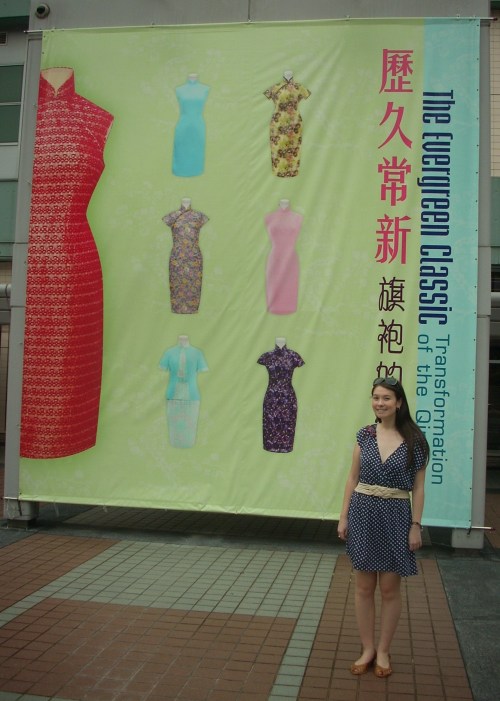
So eager was I to see Hong Kong Museum of History’s exhibition about the qipao (also known as cheongsam), my boyfriend and I showed up a month early and trotted along to the special exhibition hall on the ground floor – only to discover a display about some ancient Chinese tribe instead. Yawn. Whilst my history geek boyfriend was delighted that we got to spend a lazy day in the regular exhibition (The Hong Kong Story – review of that here), it gave us a chance to scope out the space that the qipao would be shown in – and we weren’t impressed. It seemed small, cramped and my boyfriend predicted that we’d be in and out within an hour. How wrong he was!
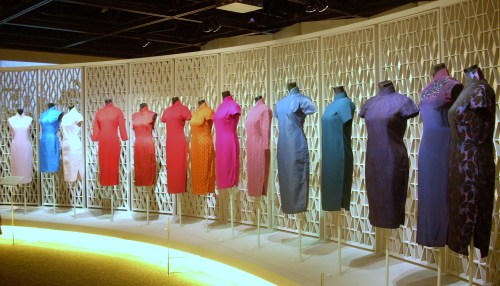
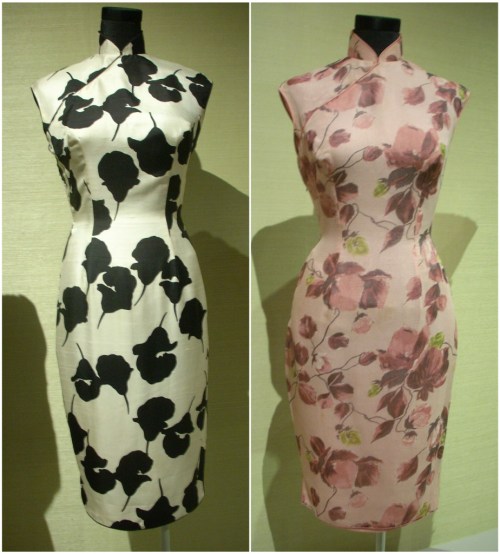
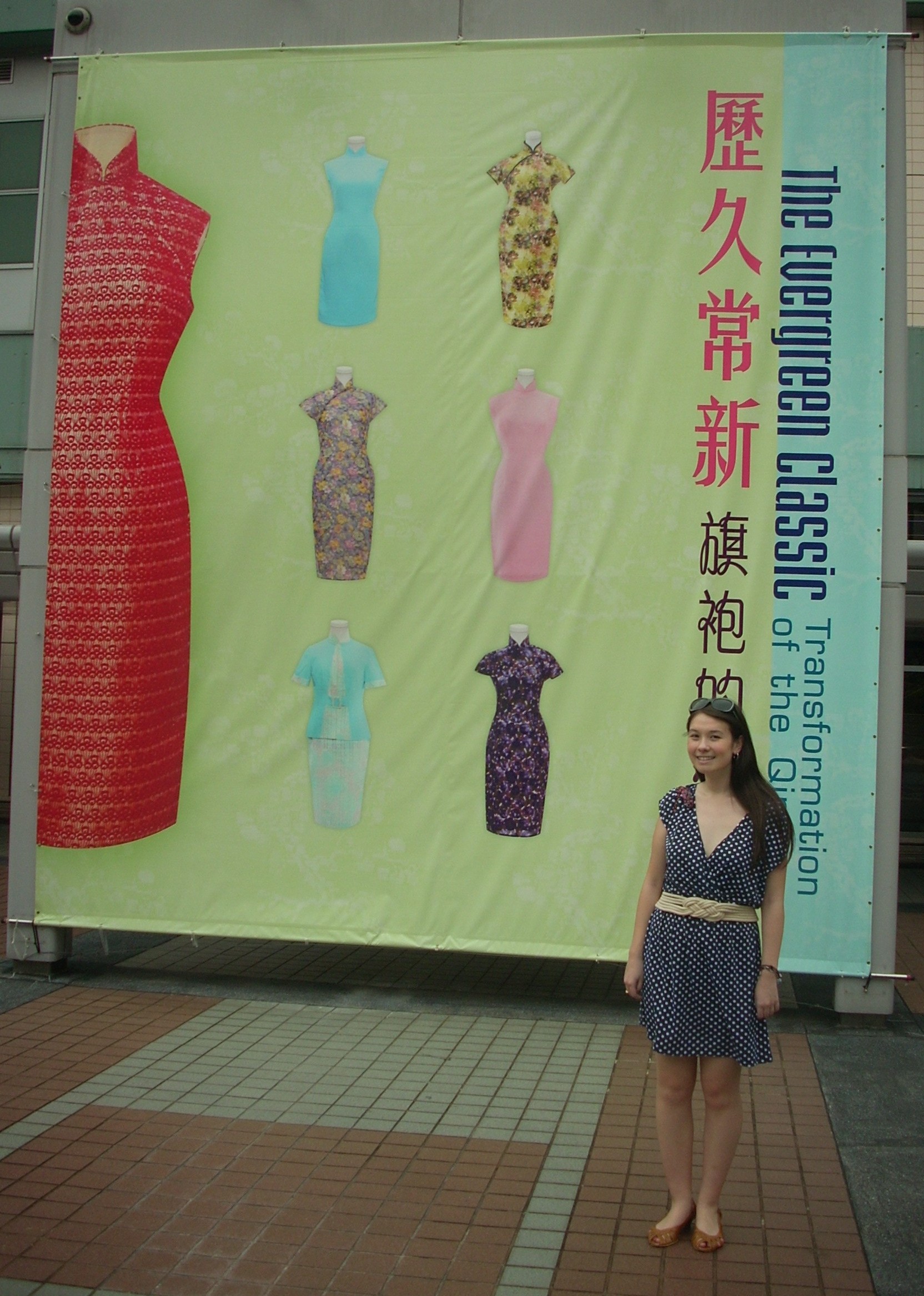
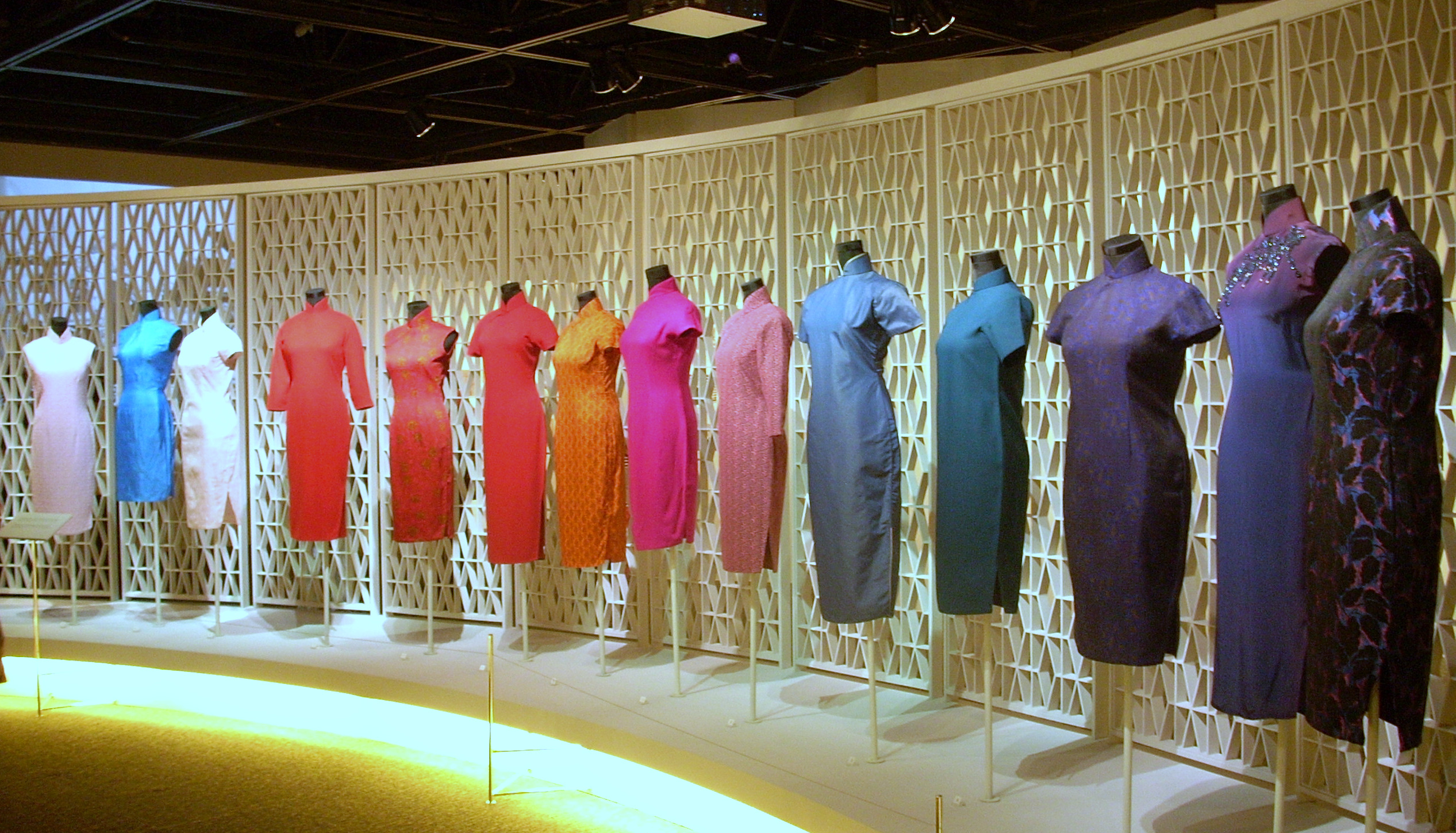
Having managed to turn up in the right month, The Evergreen Classic: The Transformation of the Qipao proved to be a stunning surprise. I had worried that it would pale in comparison with the wonderful couture exhibition (loaned from The V&A) at The Heritage Museum last year; in some ways, it managed to be better. Some 280 qipao, of all shapes, sizes, colours and textures were displayed (apparently, some with waists so tiny that custom-made mannequins had to be ordered in!), with the exhibition flowing along nicely as it detailed the evolution of the qipao from its origins in the 17th century to the modern designs we’re now more familiar with – and, despite the amount of dresses, as well as information boards, 400 pictures and videos, it didn’t feel cluttered, cramped or messy. The best part – you could really get up close to the dresses (only the oldest were displayed behind glass), marvel at the exquisite detailing and take lots and lots and lots of photos! All things you couldn’t do at the couture exhibition, in case you’re wondering.

Look but don’t touch!

So what did we learn? The qipao originated amongst the Manchu nobility of the Qing Dynasty in China, where they were long, wide and loose. Looking oddly unisex in appearance, with only fingers and the tips of the toes visible, it wasn’t exactly flattering to the female form! Even so, the detailing, embroidery and vivid colours and patterns are beautiful today, hundreds of years later.

Gradually, the form moved with the times – the dress became shorter, the fit became tighter, the famous Mandarin-style collars got higher, short bell sleeves became popular and slits were introduced to make walking easier (and show off some skin!).

Between the 1920s and 1960s, various elements came and went according to fashion – long or short skirts, plain or patterned, revealing slits, one or two pieces (like a tailored suit), being worn with Western-style fur capes or cardigans – all these trends came and went depending on whatever was “in” at the time. As with everything great and good in the world, the Chinese communists attempted to ban it – it’s figure-hugging form doubtlessly decreed too sexy for their austere tastes.

As women entered the workforce and discovered the need for more practical clothing, the tight-fitting qipao fell out of favour, making way for comfortable outfits from the West, although it survived as everyday dress in Hong Kong for a little longer, until the 1970s. Nowadays, the cheongsam is mostly famous as a national dress, worn by Asian beauty contestants, waitresses in Chinese restaurants, students at old-fashioned schools and Oriental stereotypes in movies. However, elements of design still live on in many modern garments and contemporary designers constantly play about with the form to create new, inventive takes on the qipao – with the Museum of History commissioning Hong Kong Polytechnic’s Institute of Textiles and Clothing to create some pieces for the show.

As you can see, I have dealt with the history of the qipao in a few short paragraphs and although the information boards provide a running commentary, the dresses practically speak for themselves. Because there is such little relevant information, reading these boards quickly becomes repetitive and boring, especially towards the end where there’s only so much you can write about a waitress’ uniform or a Miss Hong Kong costume. But skip these at your peril – they often include fascinating photographs, whether of the strange Manchu people with their hair piled high in some precursor to Princess Leia or more contemporary images, showing glamorous Chinese women in qipao with film-starlet hair and art-deco styling.

I was also disappointed that the exhibition failed to make much of the qipao’s strong showing in films. In the 1960s, The World of Suzie Wong and its qipao-clad star Nancy Kwan made a strong cultural impact, making the cheongsam fashionable amongst Westerners – the name Suzie Wong is still a cultural checkpoint today. More recently, in Wong Kar-Wai’s multi award-winning In The Mood For Love, Maggie Cheung wears a different custom-made cheongsam in each scene (46 in total). It’s not just for beauty’s sake either – the outfits deliberately play into Kar-Wai’s sensual evocation of mood and time, whilst the constricting nature of the cheongsam is symbolic of the theme of the moral and social restrictions placed upon the characters. It would have been nice if The Evergreen Classic had acknowledged the impact of these films on the qipao and its place in the Western mindset, with stills and video clips even if they couldn’t get hold of the costumes themselves.
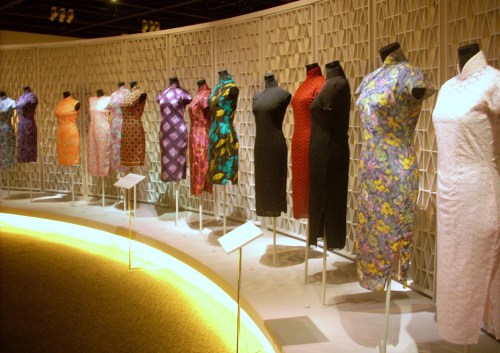
But these are minor quibbles – seeing the qipao up close, in all their glorious intricate detail, is just breathtaking. You can see the fragility of the fabrics, how the striking embroidered buttons often mirror an element of the pattern, the individual stitches on the sleeves. Amazing stuff. I guess the average person, owing to their exposure to the cheongsam in its more traditional forms, views the qipao as a timeless classic yet it’s fun to see how it adopted the fads and trends of the time – especially in the 60s and 70s, where some of the garish patterns are just as headachingly horrid as they are on Western clothes!
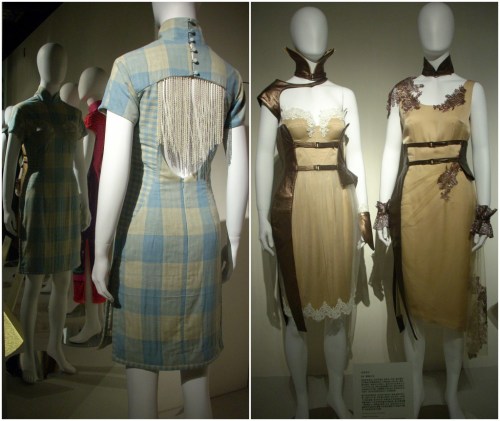
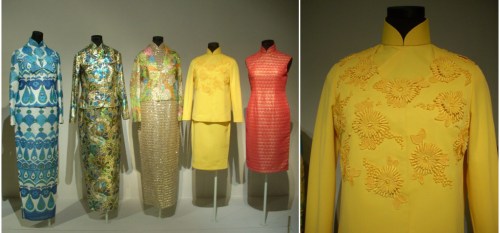
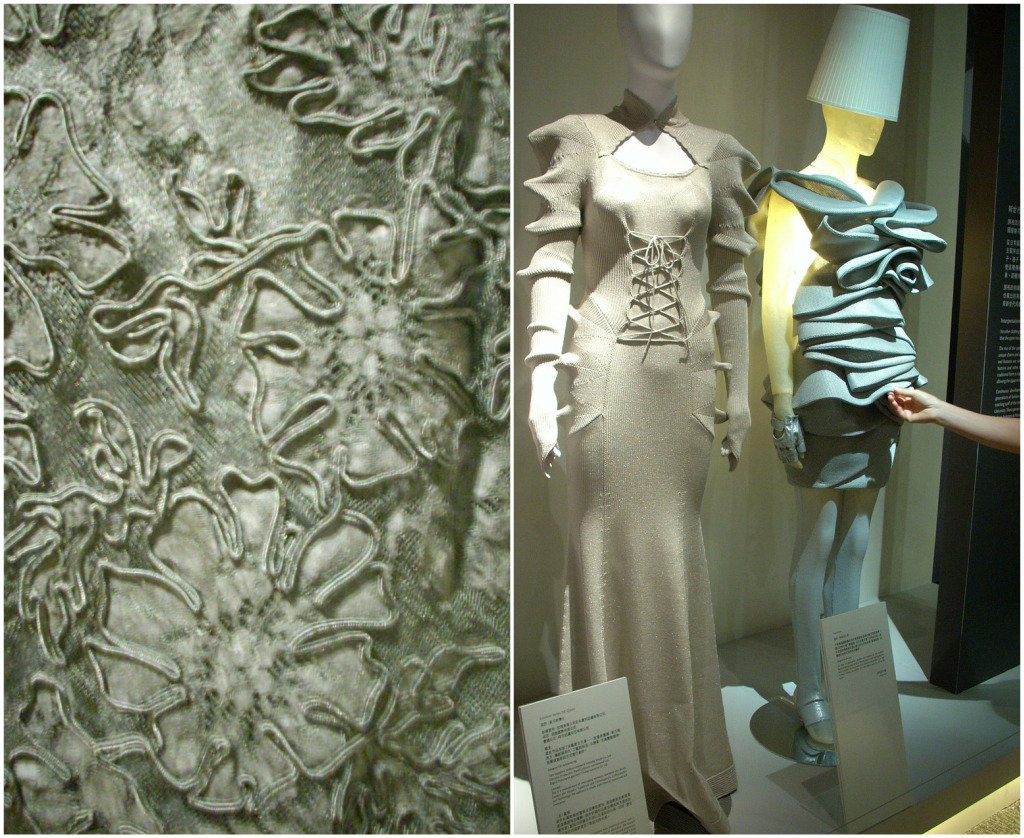
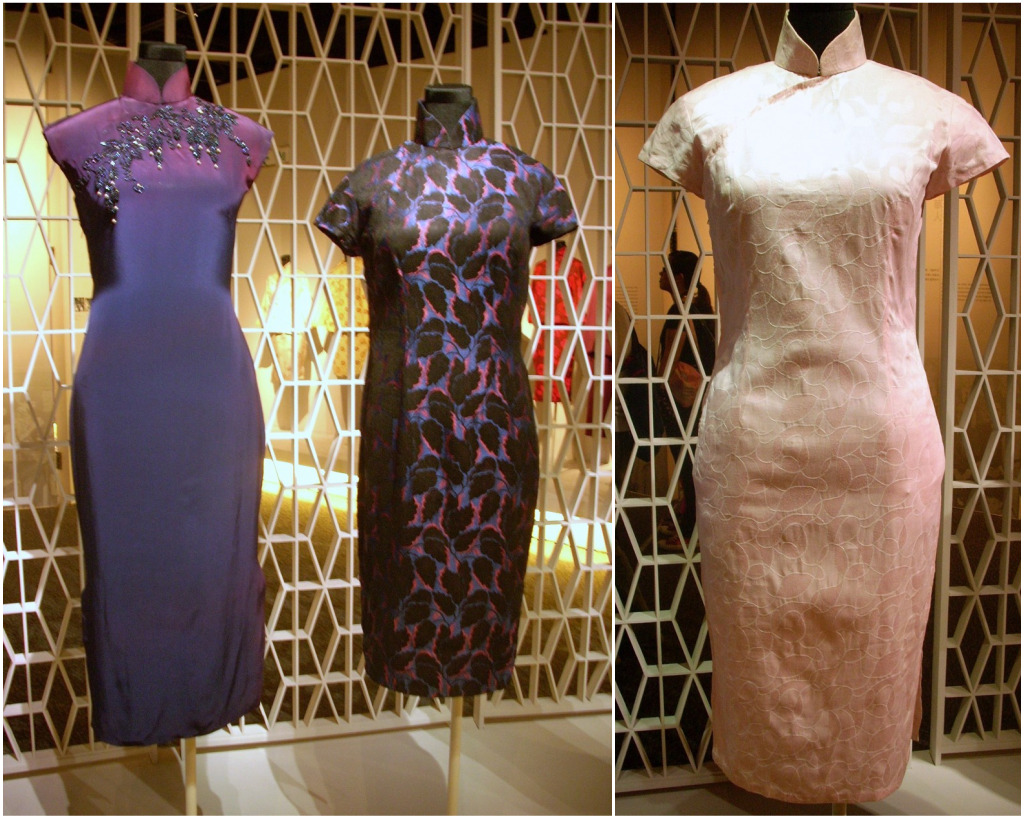
I also loved the modern constructions near the end (like the one shown earlier being fingered by a visitor), although some of these felt like advertorials for their designers.  The ones above were some of those designed by PolyU – the one on the left reminds me of something Vivienne Westwood would design (cutesy gingham print combined with the rock edge given by the back detail) whilst the ones on the right, entitled ‘Deconstruction of the Qipao’, look fit for Xena: Warrior Princess! I love how the designer has taken elements of the qipao, like the collar or the typical floral embroidery, and transformed into something totally new and modern. It would be amazing to see these kind of dresses on the red carpet, whether on Chinese or Western stars, or as stage outfits for some of the more outlandish performers out there (need I mention Gaga?!) – the quality, workmanship and sheer show-stopping quality of these outfits had needs to be seen to be believed.

Only one question remains – why oh why hasn’t a catalogue been produced? And, since it ends on 13 September, why oh why haven’t you been there yet?! [Although a lot of the pieces are on loan from real people, I’m hoping a more permanent form of this exhibition eventually makes it to The Heritage Museum – you’d best be reading LCSD!] For just $10 (and that includes the main exhibition as well), it’s a must for anyone who basically appreciates nice stuff. My boyfriend’s not into fashion at all (as his wardrobe attests, ho ho) but even he seemed to enjoy it. Go forth and qipao! And if it’s too late… here’s a few dozen of my best photos to make up for it (click for enlargements).

P.S. My favourites were from the 1950s and 60s, so there may be a slight bias. Apologies, fans of ye olde qipao.
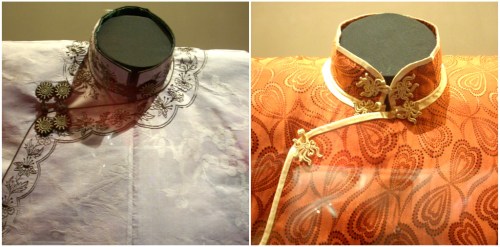
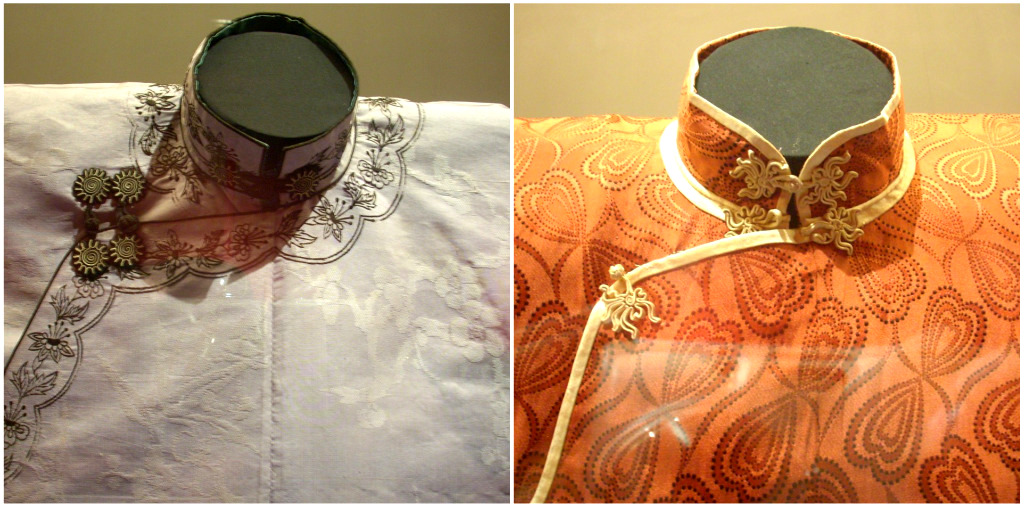
Collar detail on some of the older qipao
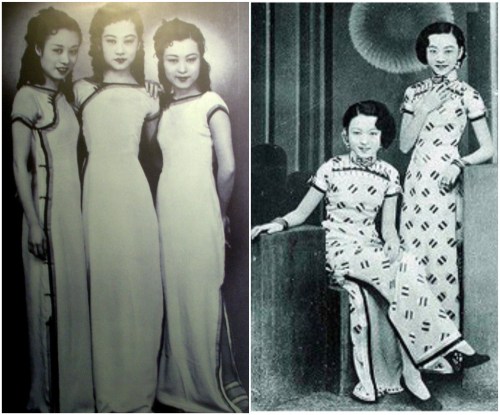
Love how glam these Shangainese girls look – traditional clothes but hair and make-up that would make any 1930s Hollywood starlet proud. And check out those cheeky side-slits!

Both red (it’s our lucky colour after all) but look at the contrast between old and new – from loose to fitted,via tailored business suit and seemingly Art-Deco print.
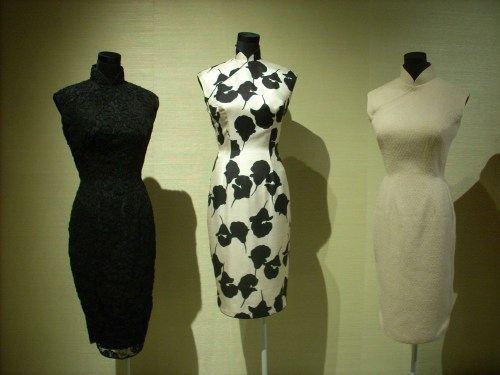
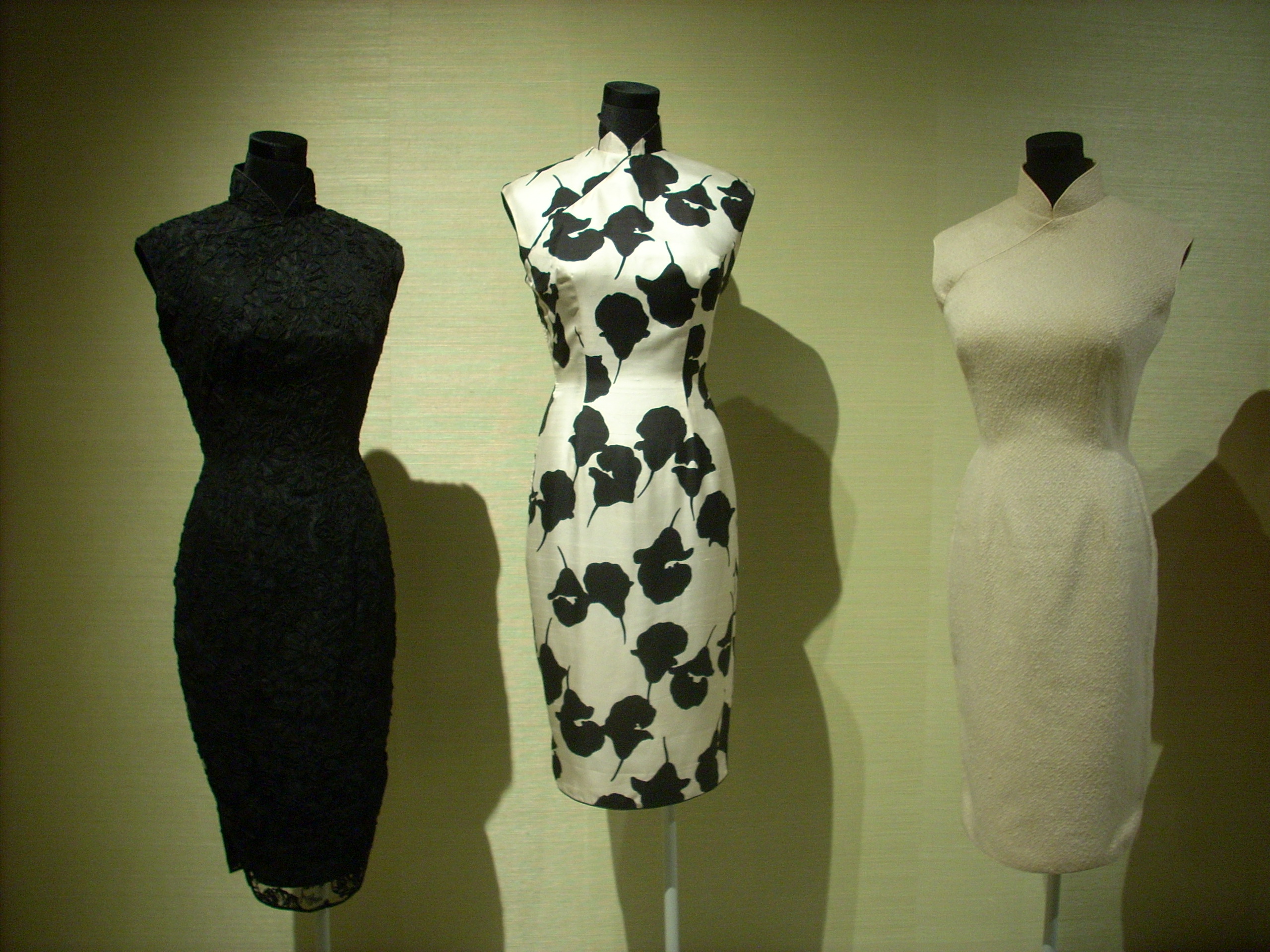
These were my favourite qipao of the exhibition; they belonged to 1950s’ HK film star, Lin Dai. The photo does not do the black cheongsam in the first picture justice – up close, you can see the lace embroidery overlay and its a subtly elegantly sexy effect. The design and prints of these are so clean and simple that they still look amazing today.

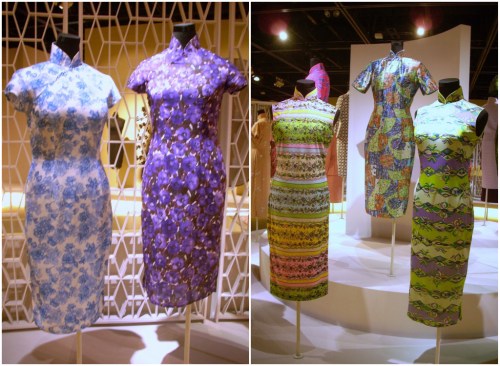
Put your sunglasses on! As I mentioned, some of the prints are very ‘of their time’ i.e. hideous now (ok, the blue florals aren’t too bad – they just look like china and give me a bit of a headache). But the detail is still gorgeous up-close.
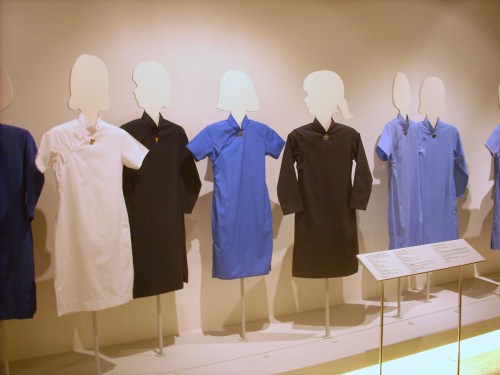
No such prints on the school uniforms! Apparently, a lot of students who have these uniforms complain vociferously about it – and once you’ve had a tight Mandarin collar round your neck in a typical HK summer, you’ll understand why!

Close-ups of the button clasps used at the collar.

I love these photos. They ‘capture a moment’ – a time when the cheongsam was everyday wear in HK.
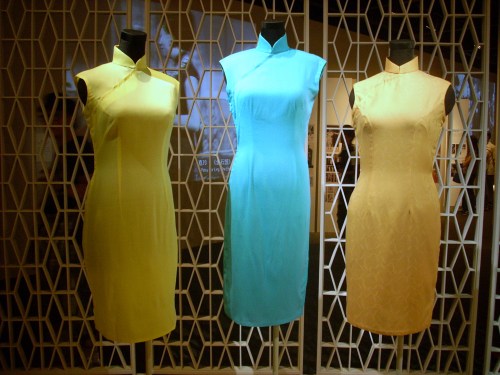
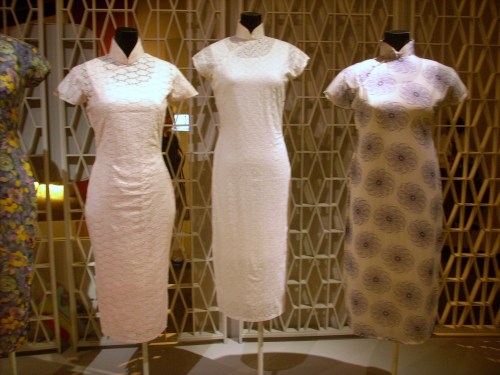
I guess these are the simpler kind of qipao you could imagine for everyday wear – but even then, the lace embroidery is still so beautiful and complex up close. I’d be constantly worried about damaging them at work!
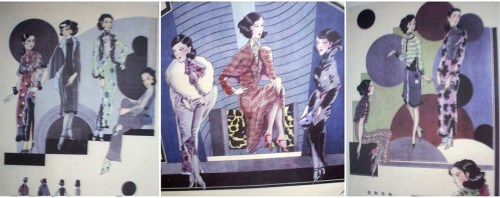
I’m a big fan of fashion sketches and found these fascinating – they’ve been drawn in that typical 50s’ style and show how the Chinese woman could Western up her outfit with a cardigan, fur wrap or jacket. It’s really unusual to see obviously Asian women being drawn in fashion sketches as well, rather than just a generic silhouette.
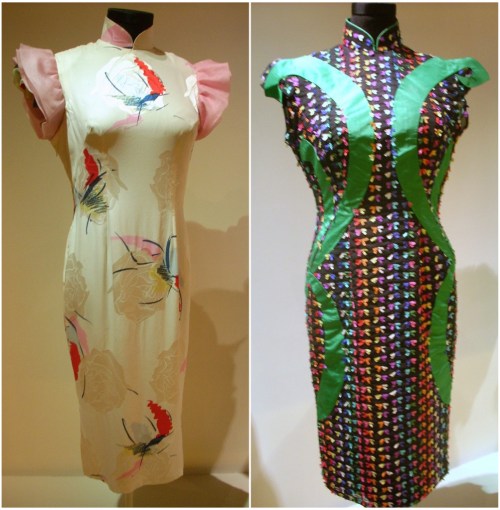
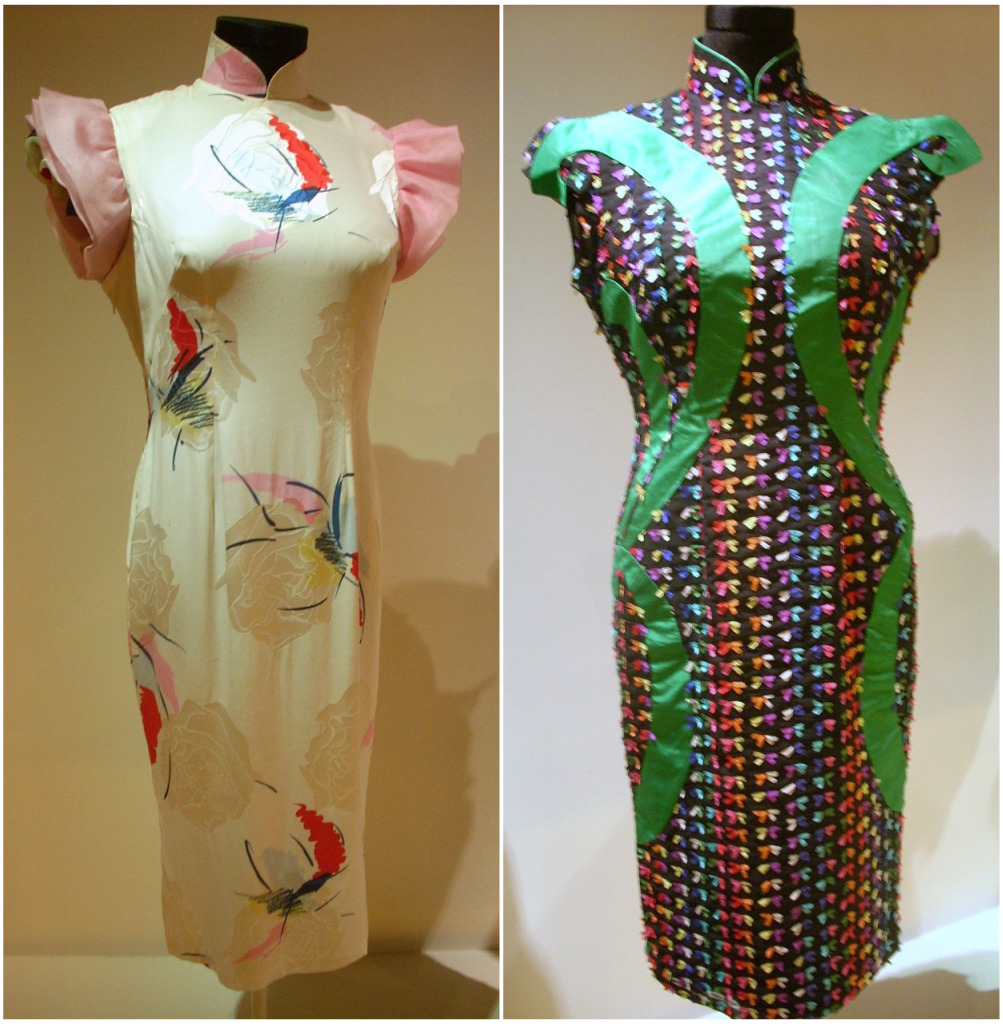
From just looking at these, you’d say 1970s right?! The frilly sleeves on the left are a new detail and the one on the right reminds of the classic Missoni print and colours, matched with the green contour lines, which are reminiscent of the whole Christopher Kane body-con thing that is happening now.

I imagine the ones on the left are more for evening wear – the midnight blue one with the sprig of glittery embellishment just looks so sleek and modern, it’s unbelievable it was made decades ago! I liked the one on the right just because the print was so subtle (squint hard to see it!) yet really lovely, fresh and youthful.
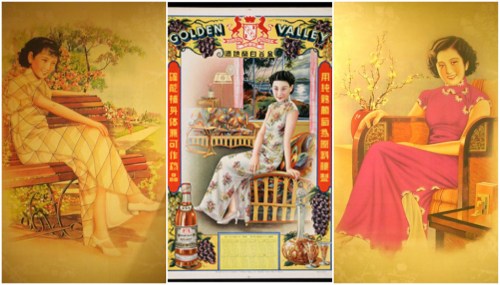
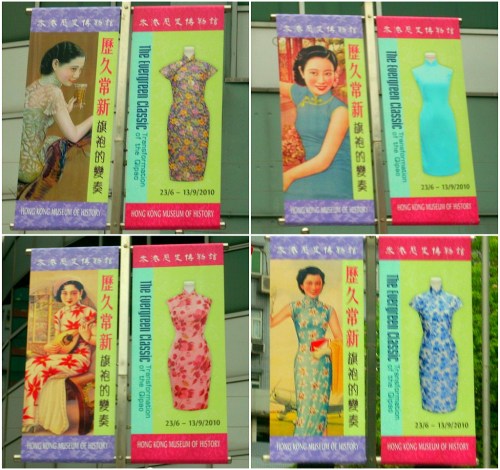
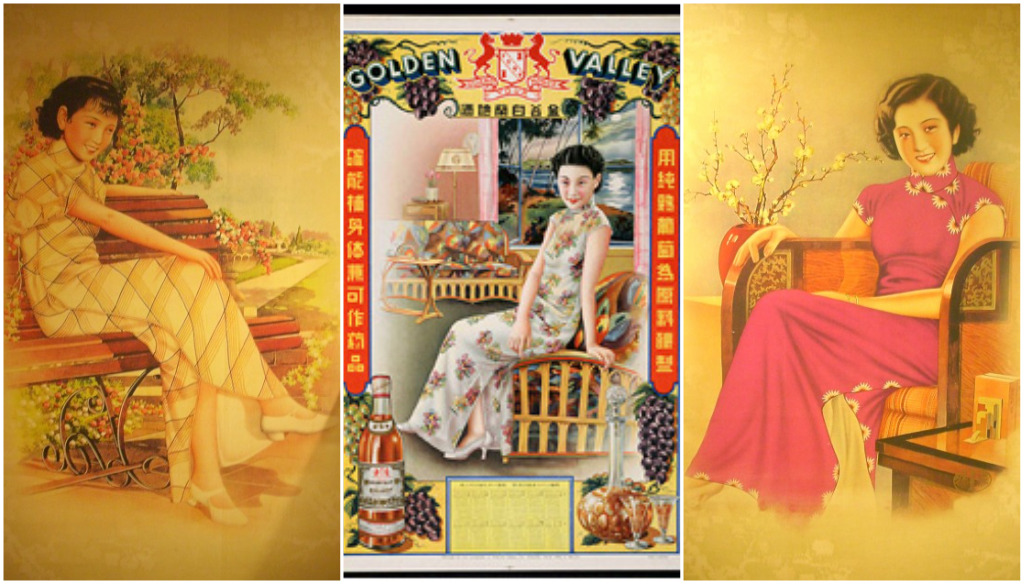
I’m also a fan of these retro drawings of stylish qipao-clad ladies that were often used in advertising in the 1930s (famous now for featuring on the Two Girls line of toiletries and cosmetics products). It’s something that the HK Museum of History has capitalised on with this very clever series of adverts, showing these traditional drawings alongside modern qipao, which look very like the ones in the pictures, that are part of the exhibit.
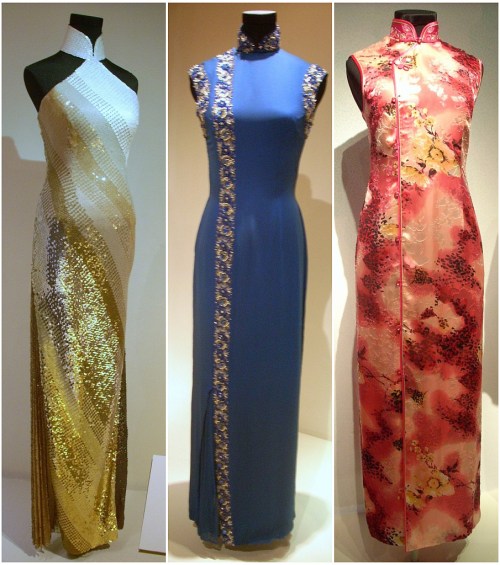
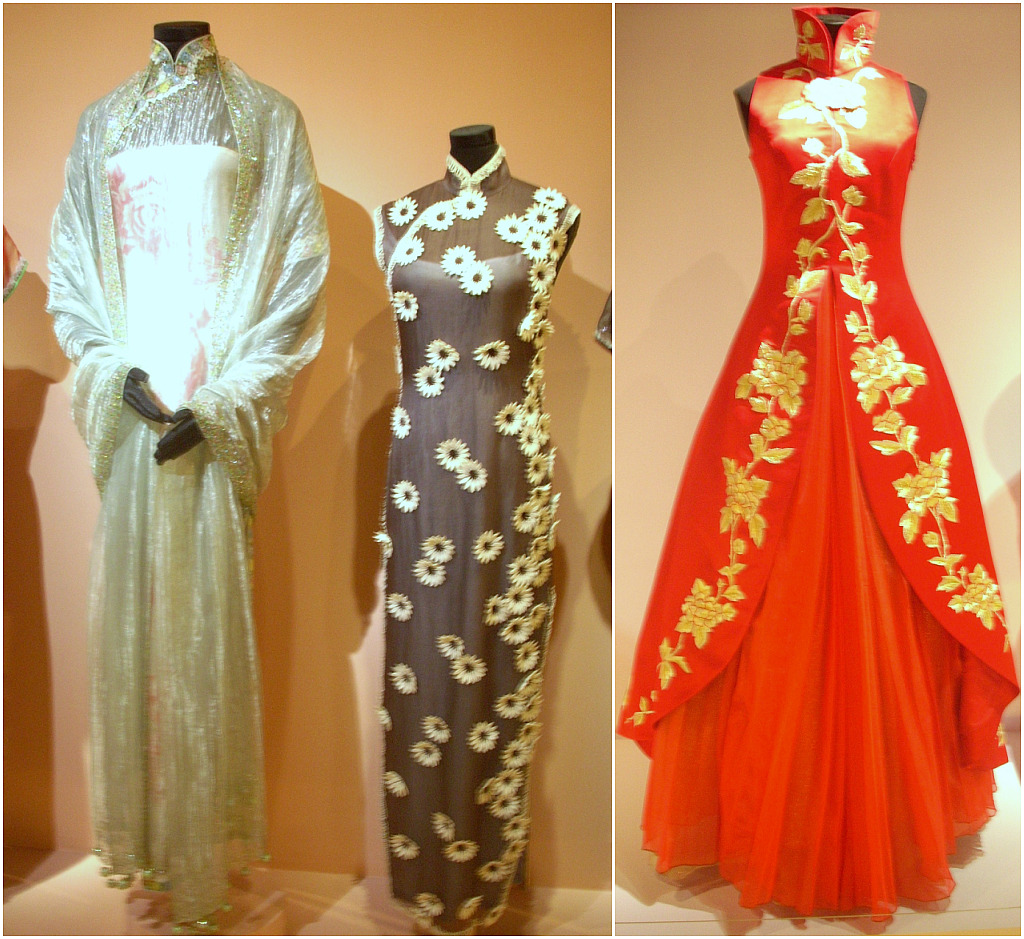
The dress on the left was worn by Michelle Yeoh at the 2002 Cannes Film Festival – a beautiful, fluid, elegant take on the qipao (love how the lines of colours emphasise the shape of the body). The middle one was worn by HK film star Josephine Siao in the 1970s – the traditional embroidered borders were taken from her mother’s collection from the 1930s! And I just liked the watercolour-style print of the one on the right, ok?!

Occasion-wear qipao! The one on the right was worn by hostesses at the 2008 Beijing Olympics Opening Ceremony (red and gold, classic combination!). I believe the one on the left was Siao’s wedding dress – it’s interesting that the typical qipao details are not on the dress itself but on the cape thing over it – and the cute flower appliques on the (bridesmaid’s?) dress are so pretty!
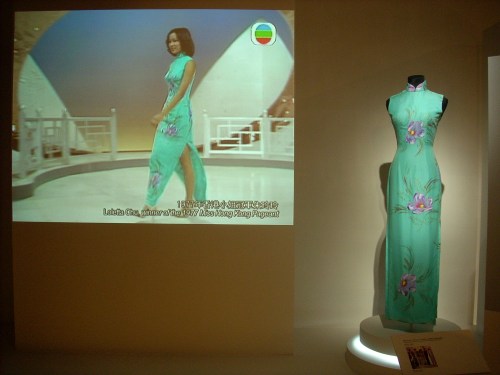
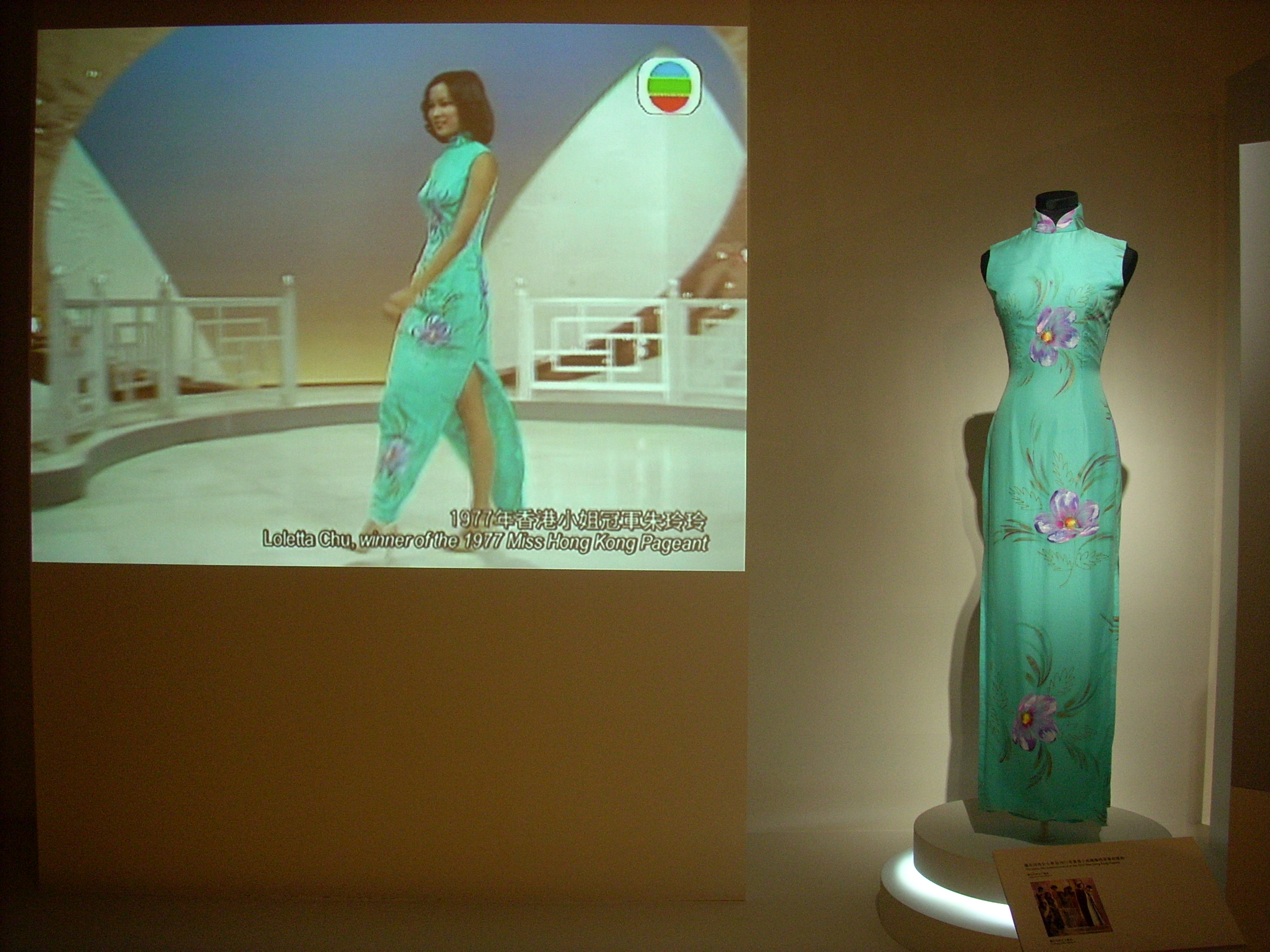
The qipao worn by Miss Hong Kong 1977, Loletta Chu. Beautiful unusual colour and floral design – definitely a stand-out at the exhibition.

This is where it gets fun, as modern designers try and put contemporary twists on the qipao whilst remaining true to the design. I think these were stage costumes for one of HK pop queen, Anita Mui’s, concerts. That cape design on the far left is so gorgeous and wintry feeling, the floral design of the second one is composed of thousands of beads (probably pain-stakingly sewn on by hand!) and the leaf detail on the other one is actually rather risque – it’s see-through! The one on the far right, again with some transparent details, is designed by Blanc de Chine and the rest may well be too but I can’t remember.

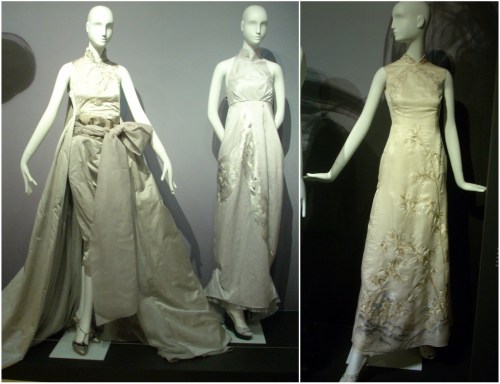
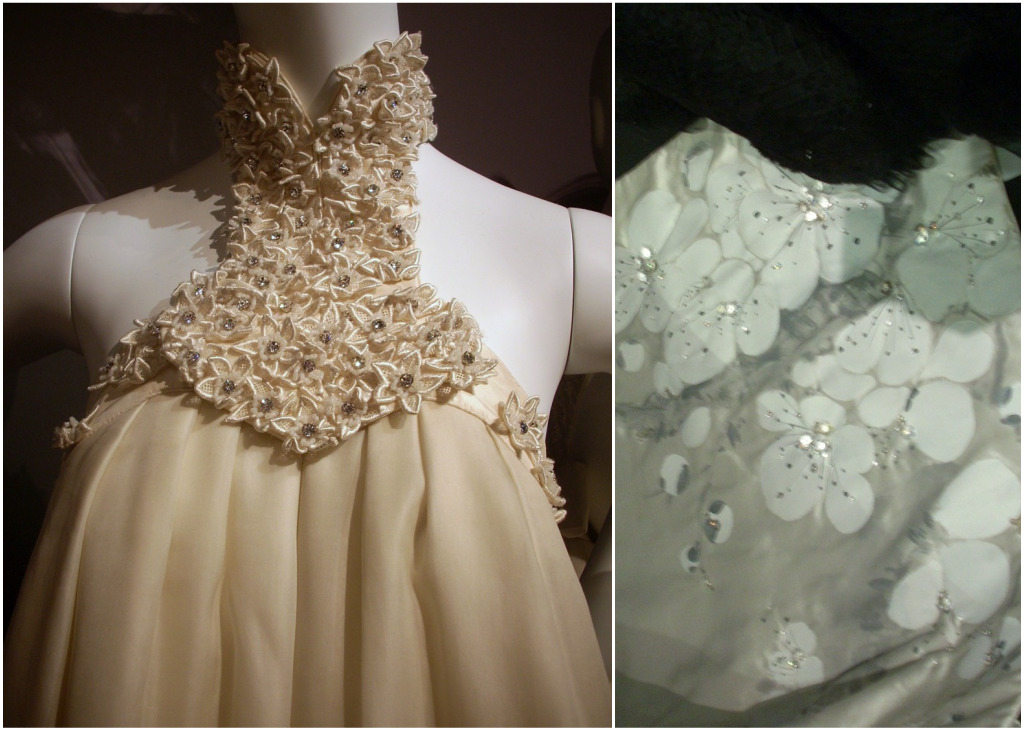
More modern qipaos, with some close-ups of the stunning details (far right is of the train of one of the dresses). I think these would make amazing wedding dresses.

And after all those photos, I hope your brower’s still working!

The Evergreen Classic: The Transformation of the Qipao is on at the Special Exhibition Gallery (on the ground floor), Hong Kong Museum of History, 23 June-13 September, 2010, $10 per person. 100 Chatham Road South, Tsim Sha Tsui, Kowloon, 2724 9402.

Exhibition pamphlet available here.

All photos taken by me or from the museum’s website.

After the exhibition has finished, you may be able to find some of the qipao either in the museum’s regular exhibition or at The Heritage Museum in Shatin.

McDonalds Hello Kitty Cosplay toys: Here kitty, kitty…

Is it me or were Happy Meal toys never this good in my day? Or just never this good in England?

Well, strictly speaking, these weren’t happy meal toys. In Hong Kong, collecting shit you don’t need has become a fine art and love of Hello Kitty certainly isn’t confined to kiddies. So all you needed to do was spend $18 at McDonalds, then add on $12 to claim a toy of your choice.

These cute kitties fell under the banner of Hello Kitty Cosplay. Just in case you aren’t sad Asian, cosplay is a fancy name for fully-grown adults dressing up at conventions, usually as comic-book or anime characters. I’m not quite sure why, when you could be Sailor Moon or Pikachu you’d want to dress up as such exotic things as “Graduate” or “Lawyer”, but Hello Kitty’s kinda ker-azy like that. The only ones I passed on were the ones dressed as McDonalds employees – I’m not even sure McDonalds employees want to dress as McDonalds employees so why Hello Kitty would want to is beyond me.

I started off only wanting “Showgirl” and “Bride”. Then I thought “London Guard” and “Air Stewardess” were cute as well. And maybe “Police Officer” too. Soon, somehow, without even realising it, I had become infected by the HK mania for collecting crap and ended up getting near enough the whole set. In HK, people collect for collecting’s sake. They’ll spend thousands at Wellcome just to save up enough stickers to claim a set of pots and pans identical to the set they claimed last year. They’ll try and survive on food bought purely from 7-11 for three months in order to amass a whole series of products slapped with the face of a Japanese cartoon character. They’ll beg, harass and attack McDonalds employees just to get the right colour Coca-Cola glass needed to complete their collection – which they won’t use but just keep in boxes and stare lovingly at on their mantelpiece. And they won’t care that for the amount of time, money and sanity wasted on doing this, they could have just got a cheaper pot and pan set/toy/glass from Ikea. But when you’re in Rome…

You gotta admire McDonalds’ marketing tack as well. These Hello Kitties were drip-fed to the hungry public like jelly babies waggled in front of toddlers’ noses for finishing off their greens. They appeared in weekly batches and you could only get two at a time, meaning you had to go twice a week for three weeks if you wanted to claim all 12. Another one was only available if you ordered a delivery and another three were only available between 9pm-4am with different ones each week. I missed out on one of these ‘after dark’ ones and my poor boyfriend never heard the end of it. You could bypass the whole collection mania by purchasing a box set (getting a special Hello Kitty and apparently “saving” $200 – except you weren’t saving, you just weren’t getting any food) – but where’s the fun in that?! I say ‘Where’s the fun?’; I mean, I was starting to have dreams about my desired Hello Kitty being sold out and knew I needed to get a life.

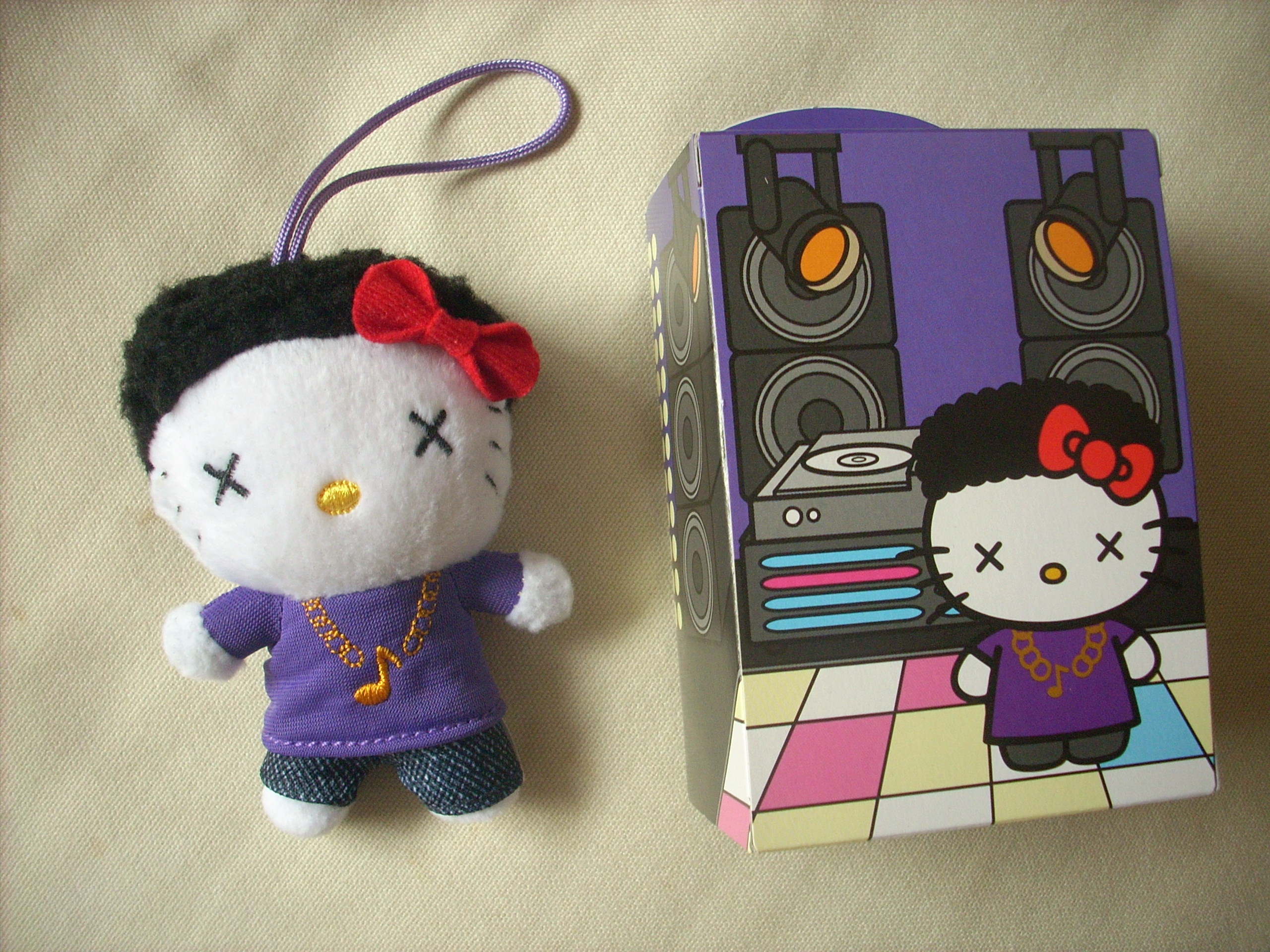
Luckily for me, my boyfriend is a McDonalds addict, with Coca-Cola flowing through his veins and French Fries propping up his organs – but even he was beginning to tire of a diet exclusively from the golden arches. I was worried he would explode, only for a shower of McNuggets to pop out. This was around the time of Shake Shake Fries and we joked that literally cross-eyed Hip Hop Hello Kitty had OD-ed on too much MSG-infused Hot n’ Spicy Shake Shake stuff. For a while, it looked like my boyfriend might follow suit.

My boyfriend at the end of the month

But anyway, it’s all over now, I got my Hello Kitties and don’t they look cute?! So now I keep them in their boxes and stare lovingly at them sitting on the mantelpiece. This is probably more proof of my burgeoning HK identity than the 3 stars on my ID card.

And if anyone has a “Pajamas” Hello Kitty going for a good price, do let me know 😉

Check out my post on some more (yes, more!!) McDonalds Hello Kitty toys here

Stick Stick Desserts – oooh, stick you!

UPDATE: All Stick Stick locations are now closed.

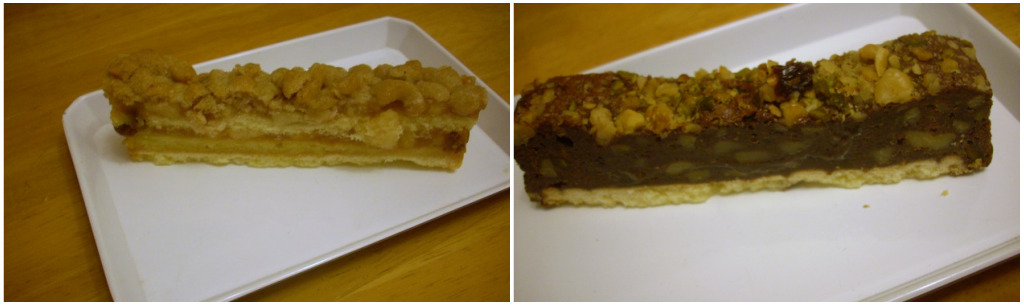
Came across these perfect little tea-time snacks in the shopping mall at Hang Hau and just had to try them. We tried the Tiramisu, Chestnut Mont Blanc, Marble Cheesecake, Strawberry Cheesecake, Apple Cinnamon and Brownie (top to bottom, left to right).

The shop is called Stick Stick – all their cakes come in these small but perfectly-formed slices, or rather, sticks. So in-keeping with the small but perfectly-formed theme, I’ll try and keep my it brief as to why I thought this was such a cute concept:

  • Each one was $10. No messing about with cents or odd numbers. Easy.
  • The perfect size – not so big that you feel fat, bored or full but big enough to quell any dessert craving….
  • And small and cheap enough to justify buying plenty of different varieties! (As if I need much excuse!)
  • Neat and tidy – biscuit base stops it from falling apart, stick shape made it easy to pop in mouth and polish off far too quickly = no mess and no washing-up!
  • YUMMY! The cheesecakes were just the right amount of sweet, the apple cinnamon was like a delicious mini apple crumble and the brownie was gooey chocolate goodness with a satisfying nutty crunch.

Decisions, decisions… (click to enlarge)

I find a lot of HK desserts overly creamy and soft so the biscuit base of these makes for a nice change. In fact, the only way Stick Stick could get any better is if it offered a few comfy chairs and coffee to make it a great stop-off for shopped-out feet in the mall!

The proof of the pudding is in the eating – literally. So here’s a picture of my auntie enjoying her Mango Stick Stick with such gusto that I didn’t even manage to get a photo of it!

The ninja of cake-eating

Stick Stick, $10 each, Hollywood Plaza (Diamond Hill MTR) and East Point City (Hang Hau MTR). Their concessions rotate round various malls and department stores in Hong Kong, so if you find one, grab some!

Hong Kong Murders: The Braemar Hill murders

Even now, the Braemar Hill double-murder provokes sadness and horror over twenty years after it happened, not just for the brutality shown to its teenage victims but also for the fact that this continues to be one of the only murder cases to involve the expat community in HK.

This was back in the old days, when colonial Hong Kong was still very much in its pomp. Kenneth McBride, 17, and his 18 year-old girlfriend Nicola Myers failed to return home after an al fresco revision session on Braemar Hill one April afternoon in 1985. The next morning, an unfortunate hiker made the grisly discovery of their badly-beaten bodies.

Braemar Hill, a luxury residential area and beauty spot, was an unlikely scene for a crime and Westerners were unlikely victims. Violence was usually confined to the triads and any previous murders in HK had been strictly local affairs. Kenneth and Nicola’s deaths sparked a huge police hunt, the scale of which HK has never seen before or since, with around 600 police officers and soldiers from the British garrison combing the area for clues, plus an aerial search by helicopter.

Whitehead fails to expand sufficiently on the issues this raises, whether through tact or wishful thinking. Her discussion that the investigation wouldn’t have commanded the same amount of manpower if the victims were Chinese is over in one sentence, and even then she qualifies it with ‘that’s not to say the case wouldn‘t have been thoroughly investigated’. Her later revelations that there was a reward for $500,000 (the largest in HK’s homicide history and a bounty that seems to have been lacking in the case of the prolific Tuen Mun Rapist) and that the Chinese press accused the police of racism, complaining about the unnecessary level of spending and use of manpower on the case, are relayed to the reader in such a colourless manner that she fails to convey the strength of public feeling about the case, which there evidently was given how widely-remembered it is even now. One HK blogger remembers blurting out “Can you imagine the Government going to all this trouble if it had been a couple of Chinese kids from a public housing estate in Kowloon?”; it’s certain he wasn’t the only one thinking it. In those days, most senior officials were expats, the them/us divide was more obvious and the one of the most shocking aspects of this shocking case was that such a thing could happen to expats in their self-anointed paradise in the first place.

The murders themselves had been brutal. Kenneth had been bound, beaten and suffocated. He had more than 100 injuries on his body. Nicola had 500. She was also bound, almost naked, had been raped and clearly tortured for a greater length of time. These brief details are horrific enough but had more been provided in Whitehead’s narrative, I feel it would have supported the assertion that police devoted such resources to the case because of the violence of the murders and not the race of the victims. It would also have helped the reader understand the true depravity of this crime and why people still shudder when it’s mentioned today.

The Chinese information reveals more – that Kenneth was strung up, beaten and strangled with an arm-sling that he was wearing, that he had obviously put up a painful struggle, that both were beaten brutally with branches, that the gang thrust a stick and a bottle into Nicola’s genitalia, that her jaw was broken, her left eyeball was out its socket, that she had an expression of terrible suffering on her face. Yes, these details are truly terrible but I think they’re important to highlight the utter heinousness of this crime. I was reminded of the James Bulger case, where a long list of the sickening specifics behind his torture were released, and which I think of every time discussion of his killers crops up in the media. It is easy for people to dismiss numbers and vague generalisations of ‘bruises’ and ‘lacerations’, less so when there is some sickening bloody detail that lodges itself into your consciousness. It also indicates that Whitehead’s categorisation of the case as a ‘Sex Crime’ is flawed – the sexual element, though awful, is hardly the most significant element of or motivating factor behind the crime.

It took eight months for the culprits to be found, despite the wealth of evidence discovered at the scene (including Nicola’s torn clothing and personal effects, including pictures of life in London); forensic technology was still in its infancy and a bloodied branch with Nicola’s hair on was unsuccessfully analysed for fingerprints (there is a suggestion that the evidence was compromised by police unknowingly handling it). Superstitious HKers were spooked when one potential witness, under hypnosis by the police psychologist, began to speak more fluent English, although she only spoke broken English with a Chinese accent in real life – people believed she had been possessed by Nicola’s ghost.

It was sheer luck that an informant overheard a youth (Pang Shun-yee) boasting to his gang that he had killed a Western couple, proving it with the fact that he was wearing Kenneth’s trainers. Following their arrest, the youngest member of the gang, 15 year-old Won Sam-lung, duly confessed.

The confession is raked over only briefly in Whitehead’s account. Won said the gang spotted the couple and decided to ‘have some fun’ with them, asking if they had any money. They didn’t, were tied up and one of the group ‘sprang onto the woman like a hungry dog’. [Chinese information suggests that Pang asked Nicola to have sex with him and on her refusal, dragged her down the hill to rape her and threatened the rest of the gang to do likewise.] Pang decided they kill them, lest the pair identify them later, murdering Kenneth first before turning to Nicola. They tortured her for ‘dozens of minutes’ (the autopsy results suggest significantly longer as she died at least an hour after Kenneth) but when the gang left, she was still breathing faintly. Having witnessed the terrifying murder of her boyfriend and then been brutally raped and tortured herself, she lingered on only to die alone.

It says much about Whitehead’s lack of detail that we only learn the rest of the gang’s names in her penultimate paragraph and although she states that another of the gang confessed, we are told only one sentence of his account (this conflicts with more recent news reports that Won, who has since been released, was the only one who admitted his guilt and regularly had nightmares about his part in the murder). We never hear about the gang’s background, whether they had committed any crimes before or what drove them to such extremes for this one. We never hear the voices of the gang members who denied their involvement (later appealing against their sentences) or of Pang, whom the two confessions fingered as ringleader. One source claims that some denied raping Nicola at trial even when forensic evidence clearly proved the contrary was true. Similarly, although we learn that the case was disturbing enough to prompt the chief investigating officer, Norrie MacKillop, to quit homicide, we never learn any of his private thoughts or suppositions about the case or its perpetrators.

kenneth mcbride nicola myers braemar hill murders

However, the biggest disservice in Whitehead’s account is done to her young victims, who frankly deserve better. They warrant a mere paragraph which talks about their good looks (sans photo), clunkily linking them with some guff about seeing ‘beyond the narrow confines of a fast-decaying colonialism’ and giving no feeling of the absolute sense of loss felt by all who knew them. They were popular figures at Island School, something of a golden couple – members of the debating and rowing teams, Kenneth the president of the Students Union, who would write poetry to each other on the school roof. Former schoolmates looked up to ‘warm, bright and sunny’ Nicola (‘I wanted to grow up and be just like her’); Chris Forse, a teacher of theirs, remembers Kenneth speaking stirringly about apartheid in the school assembly the day before his death and how the rowing and debating teams went on to win in the wake of their murders – ‘was it that beam of light from the heavens?’ David James, vice-principal at the time, recalls Kenneth rallying the school to knit squares for Soweto (‘I remember him, knitting all those squares’); Kenneth’s sister, Marion (who resembles her brother so much that her parents often say ‘You look just like Kenneth when you did that’) laughs when she remembers how Kenneth and Nicola wanted to raise money for Ethiopia by gathering toys and clothes, but the parcel was so big that they didn’t have enough money for postage. ‘And I remember coming home and there was Kenneth baking cakes, and there was a smell of burned cakes in the house, and he just made all these cakes, had a cake sale the next day and that’s how they got the money for the stamps.’

Forse still keeps photos of Kenneth and Nicola and remembers his shock on hearing the news (‘I couldn’t really accept what I heard, or even continue with the conversation… I remember putting the telephone down and saying “Sorry, I can’t deal with it”); the school was overwhelmed with silence, sadness and as James says, ‘such grief… grief you could never imagine happening in a school… you don’t know what to do.’

Twenty-five years later and everyone who knew them still remembers them vividly, with a smile, fondness, warmth and sadness. It was reading these memories and seeing fuzzy photos of them looking young, bright, hopeful and idealistic that made this not just a bloody statistic in a book but a real and human tragedy, making me cry for people who died before I was even born. As Forse writes, we should ‘regret their missing years, remember their former glories and know that they will always be, in our eyes, forever young.’

Given the character of the victims, it is fitting that there is still some hope to be salvaged. Island School set up the Kenneth McBride & Nicola Myers Memorial Fund (partly-raised by students and presented for many years by Kenneth’s parents, then sister) awarding scholarships to students who would struggle financially to continue on to secondary education. The Myers and McBride families have remained close – the only time the Myers’ returned to HK after the murders was to attend the wedding of Kenneth’s sister. Won Sam-lung was released in 2004, not only with the McBrides’ blessing but incredibly, their forgiveness. He wanted to make personal apologies to the families for the ‘enormous sorrow’ he had caused, knows in his whole life he can never ‘compensate them for what they have lost’ and says, ‘I found it hard to understand being forgiven. It shocked me, but it also told me that love can change a person.’

Hong Kong may still have one of the lowest homicide rates in the world but the murders of Kenneth McBride and Nicola Myers were a harsh awakening for many. Previously, the fragrant harbour had seemed a safe escape from UK life but these deaths marked a loss of innocence for a whole generation and proved that expats were not untouchable. It is a case that will live on in history books for years to come but I hope that alongside every mention of sickening brutality and cultural landmarks, there is some tribute to the exceptional lives that were lost. The reader deserves to know, and Kenneth and Nicola deserve to be remembered. It is the least we can do for two people who will always remain forever young.

Sources:

Hong Kong Murders – an introduction

I’m hoping some people find the subject of Hong Kong Murders as interesting as I do, or else the next few posts will be really boring. As I said in my review, English-language information is difficult to find on the Internet so these posts are for those, like me, who tried to Google ‘Jars Killer’ and ‘Tuen Mun Rapist’ without much luck – and who don’t wish to spend $135 on the book like I did! I also want to specify the things that I think are missing from Whitehead’s account – maybe some reader will one day go on to write a more exhaustive study and answer my questions!

Apart from Whitehead’s book, my sources begin and end with the powers of the Web, with specific URLs given at the end of each post. That isn’t to say I haven’t dedicated a lot of time to them – my first post, about the Braemar Hill murders, has taken me days to put together. For the copious amounts of Chinese information available, I used a combination of Google Translate and my friend Adrian’s translation skills (which aren’t as good as he claimed fyi); however, there’s some difficulty in checking the veracity of these sources. Obviously they have all stemmed from some published source, given that they are ad verbatim copy-and-paste jobs, but what that source is I can’t work out. Over the years, there have also been a number of ‘True Crime’ docu-dramas on radio, television and film so it’s difficult the accuracy of these portrayals and whether they have coloured any of the Chinese accounts. I’ve given the information I found the benefit of the doubt but you’re welcome to make up your own minds.

Hong Kong Murders – Kate Whitehead review

Before my boyfriend became my boyfriend and was doing his best to scare me into soliciting his company, he told me about a HK murderer who killed female passengers in his taxi, thus ensuring I never wanted to travel alone in one again. That murderer was the infamous ‘Jars Killer’ and ever since I learnt the gory details of that case, I’ve been intrigued about what other murders may have occurred in this fair city. Enter Hong Kong Murders by Kate Whitehead.

Asking after Hong Kong Murders in bookshops lead to a few strange looks, especially as Whitehead’s other book is called Sex After Suzie Wong, making my reading tastes look somewhat deviant. I find murder interesting, partly because my father was a retired detective and partly because so few occur in Hong Kong (one of the lowest homicide rates in the world – especially if you’re not a triad) that I wanted to know more about the few that had occurred and what went behind them.

With many of the cases from decades gone by and with few involving Westerners, English-language information on the interwebz was scant and Whitehead’s book was the only literature I came across on the subject. Alas, for a book entitled Hong Kong Murders, one was a suicide, two were kidnappings gone wrong, one occurred in Macau and at least six involved either gangs or triads, who are a different kettle of (garoupa)fish entirely. The two listed under ‘sex crimes’ were really nothing of the sort and by then, we’re left with all of about four genuinely interesting murder cases.

Whitehead, however, does her best to make them as uninteresting as possible. Her background in news journalism comes through – her writing is dry, factual and rather bland. Whilst this avoids making the book sensationalist when many of the stories could easily go that way, it manages to turn gripping cases into almost anything but. Having now finished Hong Kong Murders, I’m pretty sure I could write a better book using the information from just the book alone! That’s not to say my attempt would be much better; Whitehead frequently fails to go into enough depth. We feel little empathy for the victims as their backgrounds are not detailed, we learn little about possible motivations for the murders and we get little insight from any figures within the cases – be they investigating officers, families of victims/murderers or even the perpetrators themselves, criminal psychologists, journalists covering the events at the time, lawyers, barristers, someone, anyone! The lack of depth is really frustrating, especially as it’s clear Whitehead has actually done the research and spoken to such people, but their voices are relegated to comments so short and sparse that they’re instantly forgettable.
The blurb also promises that Whitehead will reveal the “cultural fingerprints” which ‘shed light on the psyche of Hong Kong’ but the cultural context she gives is so basic and rudimentary that practically anyone who’s lived in HK for a longer than a fortnight would be aware of such information. We are treated to amazing insights like HK people don’t like to get involved (just travel on the MTR and try to make eye contact with anyone to see how that works), that the city revolves around money, that attitudes toward sexuality are suppressed and that triads exist and have customs. Wow. Enlightening.

The triad cases in particular are bogged down with detail. Names, nicknames and even more names make them confusing and it’s clear that they belong to a completely different book. Triad violence and murders are hardly surprising but of modest concern to outsiders; as one story details, when non-triads were hurt during turf wars, the boss rang up to express concern and say ‘this shouldn’t have happened’. The message is obvious – don’t get involved and you’re unlikely to fall foul of the triads’ chopper. There are countless films, novels and non-fiction books written about the triads that I imagine have superior knowledge of their rituals, and with such crimes still relatively commonplace (one gang member was run over and hacked at outside the Shangri-La in Tsim Sha Tsui only a few years back), I found these pieces the least interesting. Just go watch the Infernal Affairs trilogy, instead.

Kudos to Whitehead for still being the only book about what is a fascinating subject, but reading it leaves so many unanswered questions that it becomes a frustrating experience. With plenty of recent high-profile cases (the “Hello Kitty Murder”, Nancy Kissel and the “Milkshake Murder”, the disappearance of Ani Ashekian… only last week, a corpse was discovered in a suitcase in Yuen Long), the time is ripe for someone to re-visit this subject matter and produce a comprehensive study. Now who’s offering?

3/5

Hong Kong Murders, Kate Whitehead (Oxford University Press, 2001), $135, Page One

P.S. I think it says much for Whitehead’s, or her editor’s, lack of depth that I’m not even sure who the evil guy on the front cover is or whether he’s even real or not!

HK gets nutritional: 1 + 7 = catsuit?

After being terrorised by hands coming out from eye sockets, here’s the latest MTR advert to amuse and bemuse.

It’s to mark the advent of the new food labelling system in HK, which detail nutritional information in categories (much like the ones that have been in the UK for a while).

The snazzy slogan to promote this new law is ‘1+7’. Why not just say 8? Is this HK’s reputation for arithmetic aptitude taking it one step too far?

And why have they decided that the obvious way to help us remember this is to dress seven unsuspecting children and one helpless adult in white body-suits? Are we meant to pick our favourite smiling munchkin and thus remember that she represents sodium? No doubt they’ll soon start producing collectible toys of the whole set a la the perennially popular Happy Meals and sold-out sets at 7-11 and Circle K.

Why are the ‘saturated fat’ and ‘trans fat’ ones looking so happy – has no-one told them that they’re the baddies and should thus be represented with devil horns and forked tail? Couldn’t we at least have some Saturdays-style colour-coding scheme or some seven dwarf-style catchy nicknames to make the whole thing more memorable?

HK government marketing division – you can thank me later.

Edit: Have just figured out what they remind me of – the sperm from Woody Allen’s Everything You Always Wanted To Know About Sex, But Were Afraid To Ask. I’m fairly sure the HK Government would die if they realised this.

Advert from http://www.nutritionlabel.gov.hk